- Coin Offerings
- ICO Tracker & Research
Coin Offerings & Crypto Investments with ICOStamp: Track, Review & Invest Smarter
Coin offerings with ICOStamp track crypto investments, review projects, and analyze token sales with real data. Start investing smarter today.
What Are Coin Offerings and Why They Matter for Crypto Investors
Coin offerings — commonly structured as Initial Coin Offerings (ICOs), Initial Exchange Offerings (IEOs), or Security Token Offerings (STOs) — are how crypto projects raise capital by selling tokens to early investors. At their best, they’ve funded transformative Web3 infrastructure, from early Ethereum to DeFi protocols handling billions in daily volume. At their worst, they’ve cost retail investors hundreds of millions of dollars in rug pulls and abandoned projects.
The difference between a promising token sale and a disaster often comes down to research depth. Tokenomics structure, team transparency, vesting schedules, on-chain activity, community engagement — these factors separate the few that deliver from the many that don’t. Yet most investors spend more time researching a $200 electronics purchase than a $2,000 crypto investment.
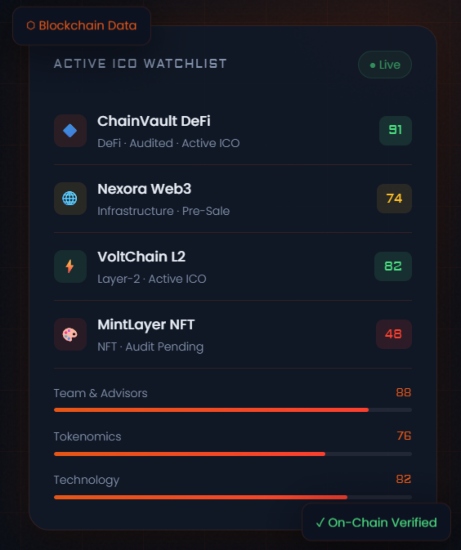
Coin offerings with ICOStamp are different. The platform aggregates project data, community sentiment, and analyst reviews into one place so you can compare opportunities side by side, track project milestones, and make decisions grounded in real information rather than social media hype.
This page walks you through exactly how to use ICOStamp to evaluate crypto investments, spot warning signs early, and build a more disciplined investment process.
How ICOStamp Tracks Coin Offerings and Crypto Projects
This platform aggregates data across four major dimensions for every listed project: team credibility, technical fundamentals, tokenomics health, and community traction. None of these alone is enough. A project can have a brilliant whitepaper and a worthless token structure. It’s value is in showing all four at once.
Project Listing and Data Sources
Every coin offering on ICOStamp is pulled from a combination of official project announcements, blockchain explorers, exchange listing data, and community-generated reviews. Projects can submit themselves for listing, but user-submitted listings go through a verification layer before appearing in ranked results. This keeps junk projects from gaming the system on day one.
For on-chain data, It pulls token contract details, wallet concentration stats, and transaction history directly from Ethereum, BNB Chain, Solana, and other major networks. If 80% of a token’s supply sits in two wallets, you’ll see that clearly on the project page — not buried in a GitHub repo.
Cryptocurrency Base Base Official Website Contract Address Networks Whitepaper Description: What ICOStamp Collects
Investors can review the official website link, the deployed contract address, the supported blockchain networks, and the full whitepaper description from a single project page. This eliminates the need to cross-reference multiple tabs or rely on unverified third-party summaries. Having all foundational project data organized in one place reduces the risk of acting on outdated or manipulated information circulating on social media.
Real-Time Status Updates
This matters more than most investors realize. Many failed ICOs from 2017 to 2020 simply stopped communicating without ever officially closing down. Investors who watched those projects closely lost less than those who assumed silence meant stability.
Community Reviews and Analyst Scores
Beyond raw data, this platform surfaces community reviews and structured analyst scores. Community scores reflect volume-weighted ratings from verified users (accounts that have held tokens or participated in sales). Analyst scores come from it’s in-house research team and external contributors, covering technical depth, market fit, and competitive positioning.
Both scores appear side by side on every project page, so you can immediately see when analyst sentiment and community sentiment diverge. That divergence is often a signal worth investigating.
Cryptocurrency Pemp Pemp Official Website Contract Address Networks Whitepaper Description
The whitepaper description gives a quick snapshot of the project’s stated utility and roadmap commitments. Supported networks indicate where the token operates and which ecosystems it connects to.This consolidated view helps investors move from initial discovery to informed evaluation without jumping between multiple sources.
Reading Ratings: What the Numbers Actually Mean
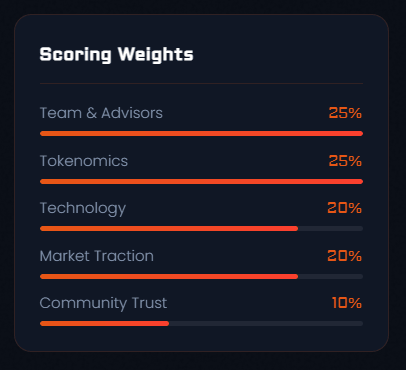
| CATEGORY | WEIGHT | WHAT GETS MEASURED |
|---|---|---|
| Team & Advisors | 25% | Verified LinkedIn profiles, prior project history, doxxed vs. anonymous |
| Tokenomics | 25% | Supply distribution, vesting schedules, lock periods, token utility |
| Technology | 20% | Whitepaper depth, GitHub activity, audit completion, testnet progress |
| Market Traction | 20% | Exchange listings, trading volume, wallet growth, social metrics |
| Community Trust | 10% | Review sentiment, complaint volume, support response time |
Why Tokenomics Gets So Much Weight
ICOStamp’s tokenomics analysis breaks these factors into sub-scores, so a project with a great team but poor token structure doesn’t hide behind a blended average.
The Community Trust Score Limitation
Ten percent might seem low for community trust, and intentionally so. Community sentiment is the most manipulable metric in crypto. Telegram channels can be filled with bots, Twitter engagement can be purchased, and Discord activity can be artificially inflated. By weighting community trust lower than technical fundamentals, this platform reduces the impact of coordinated hype campaigns on a project’s overall score.
That said, extremely low community trust scores below 30 points in that category consistently correlate with poor post-listing performance in ICOStamp's historical dataset. Pay attention when that number drops.
Step-by-Step: Researching a Crypto Investment with ICOStamp
Search and Filter by Status
Start at the ICOStamp project directory. Use the status filter to surface only Active ICO and upcoming Pre-Sale projects if you're looking for early entry points. If you're researching a project you've already heard about, search directly by name or token ticker. Don't spend time on projects marked Inactive unless you're doing historical research. The opportunity cost of investigating dead projects is real.
Check the Overall Score and Score Distribution
Look at the total score, then click through to see the category breakdown. A project with a 72 overall but a tokenomics sub-score of 38 is a different risk profile than a project with balanced 70s across all categories. The distribution matters as much as the headline number.
Read the Full Tokenomics Breakdown
Open the tokenomics tab and review: total supply vs. circulating supply at launch, percentage allocated to team/investors/ecosystem/public, vesting schedule for team and private investor allocations, lock period for pre-sale participants, and token utility. If the project doesn't publish a clear vesting schedule, that's an immediate red flag. Legitimate projects are transparent about this because it protects their long-term investor base.
Verify Team Credentials Independently
ICOStamp links to team member profiles and flags verified vs. unverified identities. For any project you're seriously considering, spend ten minutes verifying key team members independently. Search their names alongside the project name, check their LinkedIn history for consistency, and look for prior project affiliations. A CEO who lists three previous blockchain ventures is very different from one whose entire LinkedIn history appeared six months ago.
Check On-Chain Activity
For projects that have already deployed contracts, ICOStamp links directly to blockchain explorer data. Check wallet concentration, contract audit status, and recent transaction patterns. A token where the top 10 wallets hold 65% of supply has concentrated risk regardless of how compelling the pitch deck looks.
Read Community Reviews Critically
Filter community reviews by "critical" and "negative" before you read the positive ones. This takes 30 seconds and tells you more than hours of reading promotional content. Patterns in complaints — withdrawal issues, communication blackouts, whitepaper changes — are consistently predictive of problems ahead.
Red Flags in Crypto Projects and How ICOStamp Surfaces Them
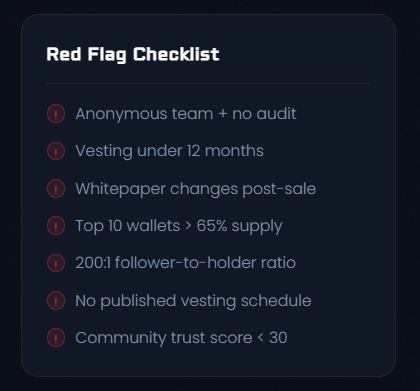
Crypto investments with ICOStamp are more defensible when you know what you’re looking for. These are the patterns that have historically preceded project failures, and where this platform makes them visible.
Anonymous Teams Without Audits
Anonymity isn't inherently disqualifying — some of crypto's most respected developers operate pseudonymously. The problem is anonymous teams without independent smart contract audits. ICOStamp flags unaudited projects explicitly. If a project has neither doxxed founders nor a completed audit from a recognized firm like Certik, Hacken, or Trail of Bits, you're operating without a safety net.
Vesting Schedules Under 12 Months
Any team allocation that vests fully within 12 months of token generation event (TGE) should prompt extra scrutiny. ICOStamp's tokenomics analyzer highlights short vesting periods in amber. Projects with three-month or six-month full vests have structurally positioned insiders to exit early, and the data bears this out: short vesting correlates strongly with post-listing price declines in ICOStamp's database.
Sudden Whitepaper Changes
ICOStamp maintains version history for project whitepapers and flags significant changes. A project that quietly removes promised features, adjusts token supply figures, or changes roadmap timelines without announcement is a project in trouble or a project that was never straight with investors from the start.
Engagement-to-Holder Ratio Anomalies
If a project has 50,000 Twitter followers and 200 actual on-chain token holders, that gap points to purchased or bot-driven engagement. ICOStamp's community analysis cross-references social metrics against on-chain wallet data to surface these anomalies. It's not a perfect science, but a 200:1 follower-to-holder ratio is not ambiguous.
ICOStamp vs. Other Crypto Research Platforms
Several platforms cover ICO listings and crypto project research. Here’s how they compare on the dimensions that matter most for investors doing serious due diligence.
| FEATURE | ICOSTAMP | COINMARKETCAP | ICO DROPS | CRYPTORANK |
|---|---|---|---|---|
| Tokenomics deep-dive | Yes | Partial | Partial | Yes |
| On-chain wallet concentration data | Yes | No | No | Partial |
| Whitepaper version history | Yes | No | No | No |
| Analyst + community dual scores | Yes | Community only | Partial | Yes |
| Project status auto-updates | Yes | Yes | Manual | Yes |
| Smart contract audit tracking | Yes | No | No | Partial |
The biggest differentiator is whitepaper version history. No other major platform maintains this. For investors who've been burned by post-investment whitepaper changes, this feature alone is worth building ICOStamp into your research workflow.
Pro Strategies for Using ICOStamp to Manage Your Portfolio
If you’ve moved past the basics and want to use icostamp.com as a systematic research infrastructure rather than a one-off lookup tool, these strategies will sharpen your process.
Build a Watchlist With Milestone Alerts
ICOStamp's watchlist feature lets you bookmark projects and set alerts for status changes, score updates, and milestone completions. Set an alert for every project you're considering so you get notified when a token sale opens, when an audit completes, or when the project hits a major exchange listing. Reacting to these events in real time rather than checking manually every week changes your timing significantly.
Track the Score Trajectory, Not Just the Score
A project sitting at 68 that was at 55 three months ago tells a different story than a project at 68 that dropped from 82. ICOStamp's score history graph shows this trajectory. Rising scores ahead of a token sale often reflect completed audits, new exchange partnerships, or growing community validation. Falling scores mid-sale deserve immediate investigation.
Use the Sector Filter for Correlation Analysis
Crypto markets don't always move uniformly. DeFi projects often correlate with Ethereum gas price trends. NFT platforms track closely with Bitcoin sentiment. Layer-2 scaling solutions have their own market dynamics. ICOStamp's sector filter lets you group your watchlist by category and spot when an entire sector is underperforming — which often matters more than any individual project signal.
Cross-Reference with Blockchain Explorers Directly
ICOStamp links to blockchain data, but for high-conviction investments, go deeper. Open the contract address directly in Etherscan or BscScan. Look at the top 20 wallet addresses and identify which are exchange wallets versus investor wallets. Check whether contract ownership has been renounced (which eliminates certain rug pull vectors) or retained (which preserves both legitimate upgrade capability and potential abuse vectors). This level of research takes 20 to 30 minutes per project. Do it for every investment above your personal significance threshold. The time cost is trivially small compared to the capital at risk.
Set a Personal Minimum Score Threshold
Establish a rule for yourself: you won't invest in any project scoring below X on ICOStamp's scale. Many experienced crypto investors use 65 as a baseline, with a requirement that no individual category scores below 50. This kind of pre-commitment rule removes emotion from the filtering process and keeps you from rationalizing low-quality projects because a friend hyped them in a group chat.
What are coin offerings with ICOStamp and how does the platform work?
Coin offerings with ICOStamp refers to how the platform tracks, rates, and organizes Initial Coin Offerings, IEOs, and other token sales for investors. It aggregates project data from blockchain networks, official announcements, and community reviews, then applies a structured scoring system across team quality, tokenomics, technology, market traction, and community trust. The result is a research dashboard where you can compare crypto projects side by side rather than hunting for information across a dozen different sources.
Is ICOStamp free to use for crypto investment research?
It provides access to its core project directory, ratings, and community reviews without charge. Advanced features — including detailed tokenomics analytics, whitepaper version history, and custom alert configurations — are available through the platform’s premium tier. For investors who regularly evaluate new coin offerings, the premium tools pay for themselves by preventing a single poor investment decision.
How does ICOStamp verify the accuracy of its project data?
It pulls on-chain data directly from blockchain explorers, which makes that data layer highly reliable. For off-chain information like team credentials, roadmap claims, and partnership announcements, the platform uses a combination of automated monitoring and manual review. User-flagged inaccuracies are investigated and corrected. No platform achieves perfect data accuracy in crypto given how fast information changes, but it’s version-tracking approach means discrepancies are documented rather than quietly overwritten.
What makes a crypto investment on ICOStamp more trustworthy than one found through social media?
Social media crypto recommendations are structurally incentivized toward hype. Influencers are frequently paid to promote projects, and coordinated pump campaigns can make low-quality tokens look legitimate for days or weeks. It’s scoring system weights technical fundamentals and on-chain data more heavily than social metrics, which means it’s harder to manufacture a high score through marketing spend alone. The platform also maintains a record of projects that failed after receiving strong community buzz — useful context for calibrating how much weight to give community sentiment.
Can ICOStamp track cryptocurrency investments across multiple blockchain networks?
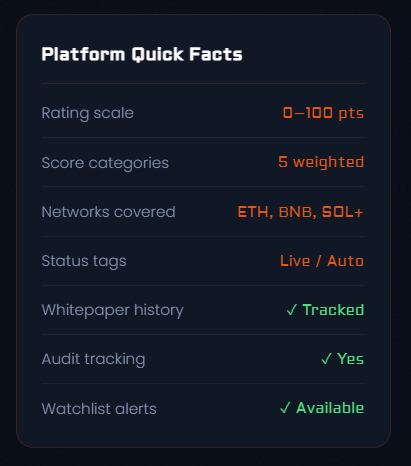
Yes. It covers projects across Ethereum, BNB Chain, Solana, Polygon, Avalanche, and other major networks. The platform’s network filter lets you segment research by blockchain, which is useful when you have a view on which network ecosystems are growing and want to focus your research accordingly.
What is tokenomics and why does ICOStamp weight it so heavily in its scores?
How often does ICOStamp update its project scores?
Does ICOStamp provide any investment advice or financial recommendations?
It is a research and tracking platform, not a licensed financial advisor. All scores, ratings, and analysis are informational tools to support your own research process. Crypto investments carry substantial risk, including the potential to lose your entire investment. Nothing on ICOStamp constitutes a buy or sell recommendation. Always conduct your own due diligence and consider consulting a qualified financial professional before making investment decisions.
How do crypto projects with ICOStamp get listed on the platform?
Projects can apply for listing directly through ICOStamp’s submission process. Submitted projects go through a basic verification layer before appearing in the directory. Listing on this platform does not constitute an endorsement — many listed projects receive low scores or are flagged for potential issues. The goal is comprehensive coverage so investors can research any project they encounter, not curated promotion of projects that pay for placement.
What's the best way to start using ICOStamp as a new crypto investor?
Make Your Next Crypto Investment Count
Crypto investments with ICOStamp give you a structured, data-grounded alternative. The platform's multi-dimensional scoring, whitepaper version tracking, on-chain data integration, and dual analyst-community ratings put you in a materially better position than investors relying on Twitter threads and Telegram groups. None of that eliminates risk — crypto remains a high-risk asset class and you should only invest what you can afford to lose — but it substantially improves the quality of decisions you can make.
Ready to go deeper? Explore ICOStamp’s full project directory to browse active coin offerings with current scores and analytics. You can also read our guide to understanding blockchain verification and why cryptographic timestamping matters for document and investment integrity.
Start Researching Smarter Today
Browse active coin offerings, compare project scores, and build your watchlist — all in one place.
Browse Active ICOs
Research coin offerings with real data, on-chain analytics, and independent scores.