- Blockchain Technology
- Blockchain & Data Logging
Blockchain Technology & Data Logging with ICOStamp: Timestamping, Verification & Digital Identity
Blockchain icostamp technology explained: how ICOStamp handles timestamping, data logging, and digital identity verification. Start securing your documents today.
What Is ICOStamp and Why Blockchain Changes Everything
That's the problem blockchain icostamp technology solves directly.
ICOStamp is a platform built around blockchain-based timestamping, digital identity verification, and data logging. It creates cryptographic records of documents, files, and data at a specific point in time — records that no one can modify, not even the platform itself. Once a timestamp is written to the blockchain, it’s there permanently, with a verifiable chain of custody tied to the original content.
The platform serves a wide range of users: freelancers protecting their creative work, enterprises managing compliance workflows, government agencies issuing digital certificates, and startups in the ICO and Web3 space looking for transparent, auditable records of their token documentation. If your work involves documents, data, or digital identities that need to be trusted by someone else, ICOStamp gives you the infrastructure to back that trust with proof.
How Blockchain Timestamping Works with ICOStamp
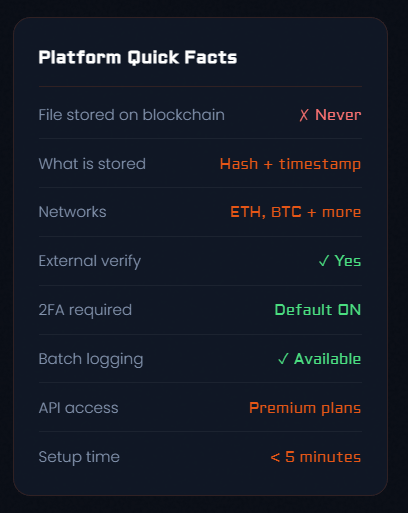
When you submit a document or file to ICOStamp, the platform doesn’t store the file itself on the blockchain. Instead, it generates a cryptographic hash of that file — a unique fingerprint derived from the file’s exact content. Even changing a single character in a 50-page document would produce a completely different hash. That hash, along with a precise timestamp, gets written to a distributed ledger.
From that point forward, anyone with the original file can run the same hash function and compare the output to the blockchain record. If the hashes match, the document hasn’t changed since it was stamped. If they don’t match, something was altered. There’s no gray area, no room for dispute, and no way to fake the result.
Why Immutable Records Matter in Practice
This use case isn't hypothetical. Law firms, creative agencies, research institutions, and compliance teams use cryptographic verification precisely because human memory and unverified files are unreliable in disputes. Blockchain timestamping makes the record speak for itself.
What Blockchain ICOStamp Supports
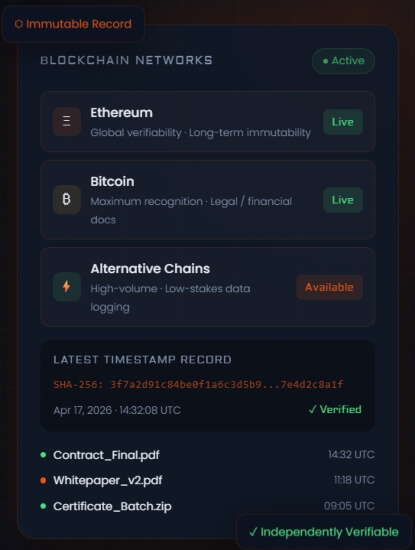
It works with multiple blockchain networks, giving you options depending on your use case and budget:
Ethereum
The most widely recognized public blockchain, with global verifiability and long-term immutability.
Bitcoin
Extremely well-established, often used when maximum recognition is needed for legal or financial documentation.
Alternative Chains
This platform supports lighter-weight options for high-volume, lower-stakes data logging workflows.
Each stamped record produces a transaction ID that you can independently verify through any compatible blockchain explorer, entirely outside the platform. That independence is intentional. You shouldn’t have to trust the platform — you should be able to verify the record yourself.
ICOStamp as a Data Logger: Integrity, Audit Trails, and Compliance
Beyond individual document stamping, ICOStamp functions as a structured data logger for organizations that need consistent, tamper-proof records across ongoing operations.
Think of the difference between sealing a single envelope and running a shipping manifest for hundreds of packages per day. Both involve verification, but the latter requires a system. It’s data logging capabilities are built for exactly that scale.
What "Data Logger" Means in the ICOStamp Context
The term data logger refers to the platform’s ability to:
Accept batches of records or files
Upload individual documents or large batches of files for simultaneous processing without manual repetition.
Hash and timestamp each item individually or as a group
Every record receives its own cryptographic fingerprint and blockchain timestamp, individually verifiable.
Organize records into a structured audit trail with searchable metadata
Records are indexed with metadata your team populates, making them searchable and reviewable at any time.
Export logs in compliance-friendly formats
Export structured logs for review, auditing, or legal discovery — formatted for direct delivery to auditors and regulators.
This makes the platform useful not just as a one-off tool but as part of an enterprise workflow. A financial services firm, for example, might run daily transaction reports through logging system to maintain an unbroken chain of records that satisfies regulators. Each day’s report gets a timestamp, and the full log shows every record in sequence with no gaps.
Compliance Use Cases
Regulatory compliance is one of the strongest drivers for adopting blockchain-based data logging. Industries where ICOStamp’s logging capabilities add measurable value include:
Healthcare
Patient record updates, consent forms, and lab results need documented timestamps that can withstand audit scrutiny.
Legal
Contracts, affidavits, and evidence records benefit from tamper-evident timestamps that courts can independently verify.
Finance
Trade confirmations, client communications, and regulatory filings often require precise timing documentation.
Technology
Software releases, code commits, and security patches can be logged with timestamps to establish version history.
It doesn’t replace your document management system. It sits alongside it, adding a cryptographic layer of verification that your existing system likely can’t provide on its own.
Audit Trails You Can Actually Use
That practical usability is what separates a genuine compliance tool from one that looks good in a brochure.
How to I Generate a Legally Admissible Blockchain Audit Trail?
Export your structured log in a compliance-friendly format directly from your dashboard. For legal proceedings, pair your blockchain records with supporting metadata such as user IDs, timestamps, and file descriptions to give the audit trail full context. Whether it holds up as legal proof depends on your jurisdiction, so consult a legal professional familiar with digital evidence standards in your region.
Digital Identity with ICOStamp: Certificates, Seals, and Verification
The core problem digital identity solves is this: how do you prove that a document, credential, or communication actually came from who it claims to come from? Email addresses can be spoofed. PDFs can be edited. Signatures can be forged. But a digital identity icostamp tied to a blockchain record can’t be faked, because the verification runs against a public ledger, not against the word of the issuer.
How Digital Identity Verification Works on this Platform
It allows users and organizations to create verifiable digital identities tied to their blockchain records. When you issue a certificate, seal a document, or sign a communication through ICOStamp, your identity is cryptographically linked to that record. Recipients can verify both the document’s integrity and the identity of the signer in a single check.
This two-layer verification (document + identity) is what makes it's approach meaningfully different from a standard digital signature. A regular e-signature tells you who said they signed. A blockchain-backed digital identity tells you who actually signed, with a record that can be audited by anyone at any time.
Certificate Issuance for Businesses and Institutions
Organizations issuing credentials, academic institutions, professional certification bodies, government agencies can use this to generate tamper-proof digital certificates. Each certificate contains a verifiable hash and a link to the issuing entity’s digital identity on the blockchain.
Recipients of these certificates can share them with employers, partners, or regulators, who then verify them instantly through ICOStamp’s verification portal without needing to contact the issuing organization. The certificate speaks for itself.
Two-Factor Authentication and Account Security
Access to ICOStamp’s stamping and identity tools is protected by robust account security measures, including two-factor authentication (2FA). This isn’t a minor feature. If someone gains access to your ICOStamp account, they could potentially issue records under your identity. Enabling 2FA closes that risk.
For organizations managing team access, account controls allow administrators to set permissions at a user level, ensuring only authorized staff can create or issue stamps and certificates.
Step-by-Step: Getting Started with Verification Tools
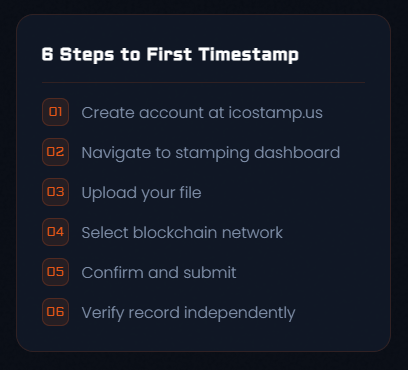
Create your account on icostamp.us
The registration process asks for basic details and prompts you to set up 2FA during onboarding. Do not skip this step.
Navigate to the stamping dashboard
Once logged in, you'll see the primary tools: Document Stamp, Batch Logger, and Identity Verification. For a single document, select Document Stamp.
Upload your file
It accepts most common file formats. The platform generates a hash of your file locally before sending anything to the network, which means the file content itself never leaves your device.
Select your blockchain network
Choose Ethereum, Bitcoin, or an available alternative chain based on your verification needs. If you're unsure, Ethereum is the most widely supported option for external verification.
Confirm and submit
It writes the hash and timestamp to the selected blockchain. You'll receive a transaction ID and a downloadable certificate of stamping.
Verify your record
Use ICOStamp's verification portal — or any independent blockchain explorer — to confirm the record exists and matches your file. This independent verification step is worth doing at least once so you understand what your counterparties will see.
For batch logging workflows, the process is similar but allows you to upload multiple records and organize them under a project or case ID. The enterprise features are documented in platform guide, which you can access from your user dashboard.
ICOStamp vs. Traditional Document Authentication Methods
| METHOD | TAMPER-EVIDENT | INDEPENDENTLY VERIFIABLE | SCALABLE | COST |
|---|---|---|---|---|
| Notarization | Partial | No (requires notary contact) | Low | High per document |
| Wet signature | No | No | Low | Low |
| Digital signature (PKI) | Yes | Partially | Medium | Medium |
| Blockchain timestamping (ICOStamp) | Yes | Yes (public ledger) | High | Low per record |
Notarization is legally recognized in most jurisdictions, but it’s slow, expensive, and requires physical presence or at minimum a certified professional. The verification process requires contacting the notary or registry, which creates a bottleneck. For high-volume workflows, this is simply impractical.
Traditional digital signatures (PKI-based) are faster and more scalable, but they rely on certificate authorities that can be compromised, revoked, or cease to operate. When the certificate authority is gone, the verification chain breaks. With this platform, the verification record exists on a public blockchain that no single entity controls or can shut down.
When Notarization Is Still the Right Call
Blockchain timestamping doesn’t replace notarization for every purpose. Legal filings, official government documents, and certain international transactions may still require notarized signatures under applicable law. ICOStamp’s timestamps can supplement notarization by creating an additional, independently verifiable record but they’re not a blanket substitute in jurisdictions where notarization carries specific legal weight.
If you’re unsure whether blockchain timestamping meets your specific legal requirements, consult a legal professional familiar with digital evidence standards in your jurisdiction.
Common Mistakes When Using Blockchain Verification Tools
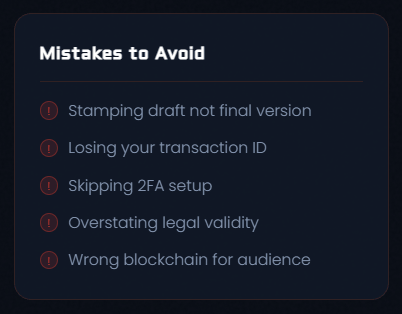
Stamping a draft instead of the final version
This is the most frequent error. If you stamp a document before finalizing it, any later changes create a hash mismatch. You'd need to stamp again, which creates two records and potential confusion. Always stamp the final, signed version.
Losing the transaction ID
Your transaction ID is your proof of record. It stores it in your account dashboard, but you should also save it independently in a secure document management system or encrypted backup. If your account became inaccessible, the blockchain record still exists, but you'd need the transaction ID to locate and verify it.
Not enabling 2FA
As mentioned earlier, your ICOStamp account controls your digital identity records. An unprotected account exposes your entire verification history. Enable 2FA on day one.
Assuming blockchain timestamp equals legal proof
A blockchain timestamp is strong evidence of when a document existed in a given state. Whether it constitutes legally admissible proof depends on jurisdiction, context, and how it's presented. Don't overstate its legal weight without understanding the applicable rules.
Using the wrong blockchain for your use case
If you need your counterparties or auditors to independently verify a record, they need access to the same blockchain. Ethereum and Bitcoin records can be verified through dozens of publicly available explorers. Less common chains may require more explanation.
Pro Tips for Advanced Users
Use batch logging for ongoing projects
If you're managing a project with multiple documents, don't stamp each one individually. ICOStamp's batch logger lets you group records under a single project ID, creating an organized audit trail instead of a scattered list of transaction IDs. This is particularly useful for legal case files, software development releases, or financial reporting cycles.
Combine ICOStamp with your existing document workflow
ICOStamp's API allows integration with document management systems. If your team uses a platform like SharePoint, Google Drive, or a custom DMS, you can configure it to automatically stamp documents at key workflow stages for example, when a contract moves from draft to approved status.
Issue verifiable certificates for your clients or students
If you run a training program, professional development course, or credentialing service, ICOStamp's certificate issuance tools let you issue blockchain-backed credentials that recipients can share and verify independently. This adds credibility to your credentials without requiring a third-party verification service.
Build verification into your client onboarding
If you send clients contracts, proposals, or terms of service, stamping these documents before delivery creates a record of exactly what was sent and when. If a client later claims they received different terms, the blockchain record settles the question.
Review your audit logs quarterly
Even if you haven't needed to reference a timestamp yet, reviewing your logs regularly helps you catch any gaps missed stamps, records that should have been logged but weren't before they become a problem.
Frequently Asked Questions
What is blockchain icostamp technology?
Blockchain icostamp technology refers to the use of cryptographic hashing and distributed ledger records to create tamper-proof timestamps for documents and data. It generates a unique fingerprint (hash) of your file and writes it to a blockchain network. This creates a permanent, independently verifiable record of when that exact file existed.
How does ICOStamp work as a data logger?
As a data logger, it accepts individual files or batches of records, generates hash-based timestamps for each, and organizes them into structured audit trails with metadata. Organizations use this functionality to maintain continuous, tamper-evident records for compliance, legal, and operational purposes.
What does digital identity icostamp mean?
Digital identity icostamp refers to the platform’s ability to link your cryptographic identity to your stamped records. When you issue a document through this platform, your identity is encoded in the blockchain record alongside the document hash. Recipients can verify both the document’s integrity and its origin in a single check.
Is a blockchain timestamp legally valid?
What blockchain networks does ICOStamp support?
It supports Ethereum and Bitcoin, both of which can be independently verified through publicly available blockchain explorers. The platform also supports alternative chains for specific use cases. Your choice of network affects external verifiability, so select based on who needs to verify your records.
Can I verify an ICOStamp record without using the ICOStamp platform?
Yes. Any record stamped through this platform can be independently verified using the transaction ID and any compatible blockchain explorer. This independence from the platform is one of ICOStamp’s most important features — you don’t have to trust ICOStamp’s servers to know your record is valid.
How is ICOStamp different from a digital signature?
A standard digital signature (PKI-based) relies on certificate authorities, which can be revoked or discontinued. It writes records to a public blockchain that no single entity controls, making the verification record permanent and independent of any centralized infrastructure.
Is ICOStamp suitable for small businesses?
Yes. It scales from individual freelancers stamping a handful of contracts per month to enterprise teams running high-volume batch logging workflows. Pricing tiers are available to match different usage levels, and the core verification functionality is accessible to users without technical blockchain knowledge.
What file types does ICOStamp support?
It accepts most standard document and file formats for hashing and timestamping. Since the platform hashes the file without storing its content, the file type affects the hash process minimally. Check this platform documentation for the current list of supported formats.
How do I get started with icostamp.com?
Create an account at icostamp.com, enable two-factor authentication, and use the Document Stamp tool for your first record. The process takes under five minutes for a single document. For batch workflows or API integration, the platform documentation walks through each setup step.
What to Do Next
Blockchain-based verification isn’t a niche tool for cryptocurrency projects anymore. It’s a practical infrastructure layer for anyone who needs tamper-proof records, auditable data trails, or verifiable digital identities. This platform brings that infrastructure to a wide range of users without requiring blockchain expertise to get started.
The key points from this guide: blockchain icostamp technology creates independently verifiable, immutable records; the data logging features support compliance and audit workflows at scale; and digital identity verification through ICOStamp adds a layer of cryptographic trust that traditional methods can't match.
Your next step is to test this with a real document. Create your account at icostamp.us, stamp a file you’d normally sign and email, and check the blockchain record independently. Once you see the verification in action, the use cases in your own workflow will become obvious.
For deeper reading, explore guides on digital stamping tools and ICO project verification to see how the platform extends into specific industries and use cases.
Timestamp Your First Document
Under 5 minutes. No blockchain expertise required. File content never leaves your device.